
Disability insurance protects your income in the event you become disabled and can no longer work. While many employers sponsor group disability benefits plans for their employees, some do not. Even if your employer offers a group disability benefits plan, it may only protect a portion of your income, such as 50% or 60% of your monthly earnings. If you are self-employed, work for an employer that does not offer disability coverage, or the coverage offered through your employer does not cover enough of your income, you can purchase individual disability insurance on your own.
Why Is Individual Disability Insurance Important?
Like many people, your income may be your most valuable asset. If you are injured or become ill and can no longer work, disability insurance protects your income. Individual disability insurance policies usually define disability as the inability to perform your own occupation, and may even relate to your particular occupational specialty. Individual disability insurance may also insure a portion of your income if you can perform some, but not all, of your regular job duties.
How Much Will You Receive From Individual Disability Insurance?
Unlike group disability plans that usually cover a percentage of your monthly income, most individual disability insurance policies provide a flat benefit amount based on your earnings. Distinct from group disability benefits, individual disability insurance benefits are usually not reduced by other benefits to which you may be entitled, such as Social Security disability benefits.
How Long Do Individual Disability Insurance Benefits Last?
Most disability benefit plans will pay benefits until you reach normal retirement age. In comparison to group disability benefits plans, some individual disability insurance policies will pay benefits for a longer duration, and sometimes even for your entire life, so long as you continue to remain disabled.
What Do You Need to Submit an Individual Disability Insurance Claim?
If you are thinking about submitting a claim for benefits under your individual disability insurance policy, you must be receiving treatment from a qualified medical or mental health provider. You will need to provide detailed information about how your injury or illness impacts your ability to work and carry on your daily activities. You will also need to produce a record of your treatment, medications, and restrictions and limitations.
Why Do Insurers Deny Individual Disability Insurance Claims?
There are many reasons why an insurance company may deny your claim for individual disability insurance benefits. The insurer may allege that you have not provided adequate proof of your disability or simply dispute that your injury or illness is severe enough to prevent you from working. Whatever reasons the insurance company provides to deny your claim, you have options. It is important that you consult with experienced legal counsel like the attorneys at DeBofsky Law.
Know Your Rights
Individual disability insurance protects you and your income in case of an injury or illness, and it can make up for the shortcomings of employer-sponsored group coverage. If you are considering filing a claim for disability benefits, or have already submitted a claim for disability benefits that was denied, you may need to consult with an experienced disability benefits attorney.
Does This Apply to You?
Contact DeBofsky Law for an attorney consultation. We will work with you to figure out your problem, and how we can help.
What Are Your Legal Options if Your Individual Disability Insurance Claim Is Denied?
Was Your Individual Disability Insurance Claim Denied?
If you have individual disability insurance, can no longer work, and are considering filing a claim for disability benefits, or you have already submitted a claim for disability benefits that was denied, you may need to consult with an attorney. The disability and bad faith attorneys at DeBofsky Law are here to help you protect the benefits you are entitled to receive. You have been paying premiums on your individual disability insurance policy for years, and we will ensure that the insurance company also lives up to its end of the bargain and pays the disability benefits you deserve.

Individual Disability Insurance FAQs
What can I recover if my individual disability insurance company denies my claim in bad faith?
It depends on the state, the policy, and what the insurer did. Individual disability insurance claims are governed by state contract and insurance law, not by federal ERISA. State law typically allows recovery of the benefits owed, consequential damages caused by the insurer’s denial, attorney fees and costs, bad faith damages where state law recognizes the claim, and punitive damages in some states for particularly egregious conduct.
By contrast, ERISA group claims (employer-sponsored) limit recovery to the benefits owed plus, when you prevail, attorney fees. ERISA does not allow consequential, bad faith, or punitive damages. The recovery on an individual policy claim can be substantially larger than on a comparable ERISA group claim because of these differences.
How is the appeal process different on an individual disability policy compared to an ERISA group policy?
Individual policy:
- No federal-law requirement to exhaust an internal appeal before suing
- Right to a jury trial in state court (and in some federal cases)
- Right to full discovery, including depositions of insurer witnesses and adjusters
- Bad faith claims and consequential damages may be available under state law
ERISA group policy:
- Mandatory administrative appeal before filing suit, generally with a 180-day deadline
- No jury trial; case is decided on the administrative record by a federal judge
- Discovery is generally limited to what is in the file
- Recovery limited to benefits owed plus, when you prevail, attorney fees
Identifying which framework governs your claim is the first step in evaluating the case.
What is the difference between own-occupation and any-occupation coverage in an individual disability policy?
Own-occupation coverage pays benefits when you cannot perform the material and substantial duties of your specific occupation, even if you can do other work. Any-occupation coverage pays only when you cannot perform any work for which you are reasonably qualified by education, training, or experience.
Most individual disability insurance policies are own-occupation, often with specialty-specific definitions for physicians, dentists, attorneys, and other professionals. This is one of the major reasons high-earning professionals carry individual policies in addition to (or instead of) employer group coverage. Group ERISA disability policies typically shift from own-occupation to any-occupation at the 24-month mark; individual policies usually do not have that shift.
Read your policy carefully or have an attorney review it. The own-occupation definition is one of the most consequential provisions in your contract.
What happens to my individual disability policy if I change jobs or stop working?
An individual disability insurance policy is your contract directly with the insurance company and is not tied to your employer. Changing jobs does not affect the policy. Stopping work for any reason does not cancel coverage as long as premiums are paid. You can even change occupations without losing coverage in most policies. The benefit payable depends on the occupation you are performing if and when you become disabled if the policy has an own-occupation rider.
What this means:
- Changing jobs does not affect the policy
- Stopping work for any reason does not cancel coverage as long as premiums are paid
- You can change occupations without losing coverage in most policies
- The benefit payable depends on the occupation you are performing if and when you become disabled if the policy has an own-occupation rider
Some policies contain specific provisions related to occupation changes or extended unemployment that affect coverage. Review your policy carefully and consult an attorney if you have questions about how an employment change affects your coverage.
What riders should I consider on an individual disability insurance policy?
Are group and individual disability insurance benefits taxable?
It depends on who paid the premiums. If you paid premiums with after-tax dollars, benefits are generally not taxable. If your employer paid premiums or you paid with pre-tax dollars, benefits are generally taxable as income. If you paid part with pre-tax and part with after-tax, benefits are taxable in proportion to the pre-tax premium contribution.
- If you paid premiums with after-tax dollars: Benefits are generally not taxable income.
- If your employer paid premiums or you paid with pre-tax dollars: Benefits are generally taxable as income.
- If you paid part with pre-tax and part with after-tax: Benefits are taxable in proportion to the pre-tax premium contribution.
This makes a substantial difference in real income. A 60 percent income replacement benefit can be 60 percent net (when premiums were paid with after-tax dollars) or about 40 percent net (when premiums were paid with pre-tax dollars, depending on tax bracket). This is a key reason many high earners purchase individual policies with after-tax dollars even when they have employer group coverage.
Consult a tax professional for your specific situation.
What is the difference between non-cancelable and guaranteed renewable individual disability policies?
Both terms describe the insurer’s right to change your policy after issuance, but they have different consequences. A non-cancelable policy locks in coverage and premiums: the insurer cannot cancel, change the terms, or raise premiums as long as you pay the scheduled premium. A guaranteed renewable policy locks in coverage but not premiums: the insurer cannot cancel as long as you pay, but the insurer can raise premiums (typically only when applied to all policyholders in your class). Most professional individual disability policies are non-cancelable for the most important features (coverage and definition of disability) and guaranteed renewable as a baseline.
Non-cancelable (Non-can): The insurer cannot cancel your policy, change the terms, or raise premiums as long as you pay the scheduled premium. The policy is locked in.
Guaranteed Renewable (GR): The insurer cannot cancel your policy as long as you pay premiums, but the insurer can raise premiums (typically only when applied to all policyholders in your class).
Most individual disability policies sold to professionals are non-cancelable for the most important features (coverage and definition of disability) and guaranteed renewable as a baseline. Read your policy declarations to confirm which provisions are non-cancelable and which are guaranteed renewable. The distinction matters for long-term financial planning.
How do my individual and group disability policies coordinate when I have both?
It depends on the policies. Some pay independently of each other; others have offset provisions that reduce one based on the other. As a general rule, most group ERISA disability policies offset Social Security Disability Insurance (SSDI) benefits dollar-for-dollar, while most individual policies do not offset SSDI (although some pay an additional premium if Social Security is not awarded). The combination of group, individual, and SSDI benefits can substantially exceed what any single source provides.
Common scenarios:
- Group ERISA policy pays its benefit (typically a percentage of salary). Individual policy pays its scheduled monthly amount. Total income replacement may be higher than either policy provides alone
- Some individual policies are designed to coordinate with group coverage and reduce the individual benefit by the group amount. Read the policy carefully
- If you receive Social Security Disability Insurance (SSDI), most group ERISA policies offset SSDI dollar-for-dollar; most individual policies do not offset SSDI
The combination of group, individual, and SSDI benefits can substantially exceed what any single source provides. An attorney can help you maximize coverage across multiple policies and identify offset provisions in advance.

“It’s a joy to have the process over and a favorable decision issued.”
“Mark – Thank you so much, to you and the team that worked on my case. It has taken me a little bit of time to believe the good news. It’s a joy to have the process over and a favorable decision issued. I am much appreciative of the work and guidance you provided. I felt reassured from our first phone call and more so each time I saw the effort and expertise you brought to my case. Thank you again!”
T. H. | Client
Learn More About Disability Benefits Law to Protect Your Rights

8th Circ. Ruling Raises Bar For Seeking Disability Benefits
The U.S. Court of Appeals for the Eighth Circuit recently underscored the difficulty of securing Social Security disability benefits. In Post v. Bisignano, the court affirmed the denial of benefits to a claimant whose hand, arm and shoulder impairments had required...
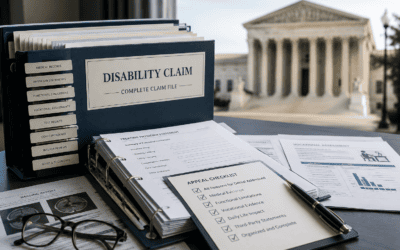
The ERISA “Administrative” Record: How to Build the File That Wins Your Disability Appeal
If your long-term disability benefit claim was just denied, your first instinct is probably to gather more records and send them to the insurance company with the expectation that a little more evidence will suffice. That instinct is the right one, but the stakes are...

When Your Disability Claim Is Denied Because the Insurer Says You Were Not Actively at Work
You filed a long-term disability claim. Your doctors support you. The medical evidence confirms you cannot work. Then the denial letter arrives, and it does not mention your medical condition at all. Instead, the insurer points to a clause in your plan called the...