
ERISA Protects Your Promised Benefits
Employees who receive benefits such as health care, disability insurance, and a 401(k) retirement plan from their employers have legal rights under the federal Employee Retirement Income Security Act (ERISA) and its amendments. Under ERISA, you have the right to:
- Establish a grievance and appeals process to get your benefits
- Sue for your rightful benefits
- Sue for breaches of fiduciary duty
- Keep your health insurance for a limited time after a loss of job
- Fight discrimination in health care
ERISA law covers more than you think. It protects the benefits you rely on. To ensure the protection of those rights, you need an ERISA attorney you can depend on. With over 60 years of combined legal experience and over 100 appellate decisions to our name, DeBofsky Law knows how to use the ERISA statute to hold employers accountable and get you the benefits you were promised.
What Is the ERISA Law?
ERISA (29 U.S.C. § 1001 et seq.) is an expansive federal statute that was enacted in 1974 to prevent pension plan abuses. ERISA requires that pension assets be held in trust, and it imposes fiduciary duties and reporting requirements on employers and plan administrators. ERISA also established the Pension Benefit Guarantee Corporation (PBGC), which provides relief to participants in failed pension plans.
ERISA has broad preemption language (29 U.S.C. § 1144) that supersedes all state laws that relate to employee benefits, except for criminal laws, insurance laws, and laws that regulate banking and securities. ERISA provides the exclusive remedy for a denial of benefits or breach of fiduciary duty, and it supersedes state bad faith laws and laws providing compensatory and punitive damages.
ERISA (29 U.S.C. § 1140) makes it unlawful for an employer to retaliate against a plan participant or beneficiary for exercising his or her right to employee benefits, or for blowing the whistle on plan abuses and fiduciary misconduct.
We Set the Bar in ERISA Litigation
We fight for our clients in state, federal, and appellate courts in disputes with employers, insurance companies and retirement fund managers.
Our Founding Partner, Mark DeBofsky, Explains ERISA:
Mark DeBofsky is the founding partner of DeBofsky Law and a nationally recognized authority on ERISA and employee benefits law. With decades of experience representing individuals in disability, retirement, health, and life insurance benefit claims, Mark has argued landmark cases before federal courts, shaping the interpretation of ERISA Nationwide. He is also a frequent lecturer, author of numerous articles on employee benefits litigation, and an adjunct professor at a leading law school.
What Does ERISA Apply to?
ERISA is noteworthy for its breadth. It applies to all employer-sponsored benefit plans, including not just pension benefits but also health insurance, disability insurance, life insurance, accidental death and dismemberment insurance, and even severance benefits, among others.
ERISA applies to all employer-sponsored benefit plans, regardless of the size of the employer or number of employees, subject to only a handful of exceptions:
- Government employers are exempt from ERISA;
- Religiously-affiliated employers (aka “church plans”) are exempt from ERISA (but can opt into ERISA regulation);
- “Payroll practices,” such as short-term disability plans that pay an employee’s salary from an employer’s general assets, are exempt from ERISA;
- Voluntary insurance that is made available by an employer, but where participation is voluntary, not endorsed by the employer, and the employee pays the premiums, is exempt from ERISA; and
- Individual insurance or retirement benefits that are purchased or obtained by the employee outside of the employment context are exempt from ERISA.
What Does an ERISA Attorney Do?
An ERISA lawyer can help you by confirming that ERISA applies to your claim and by obtaining the governing plan documents from your employer. The lawyer should counsel you as to the plan terms and identify other employee benefits and employment laws that are implicated by your situation. An ERISA lawyer can assist you in preparing a benefits claim and can anticipate issues to avoid a claim denial. If your claim is denied, an ERISA lawyer should obtain the claim file and use that information to inform his or her strategy concerning your appeal.
If your appeal is denied, an ERISA lawyer can assist you by filing a suit on your behalf against the appropriate parties, in the ideal jurisdiction, citing all viable theories of recovery. An ERISA lawyer can negotiate a settlement with the other side or, if settlement discussions fail, take your case to judgment (and, if necessary, to the court of appeals) until you receive justice.
What Remedies Are Available Under ERISA?
ERISA remedies for a denial of benefits are very limited. An ERISA plan participant can recover the benefits due to him or her through the date of judgment, as well as potential interest and attorneys fees. Claimants cannot recover compensatory or punitive damages. Similarly, in a suit for plan-wide relief, individualized relief is generally not available, although a participant in a 401(k) plan may sue a plan administrator for losses that affect only that participant’s account.
A participant may use an ERISA plan administrator to obtain “other appropriate equitable relief” (including, potentially, “make whole” relief), but such relief is generally not available where the plan language unambiguously forecloses benefits.
Remedies are also available if a plan administrator fails to respond to a request for plan documents, and employment retaliation related to benefits claims and whistleblower claims.
What Does an ERISA Attorney Charge?
There are a variety of ways in which an ERISA lawyer may structure his or her attorney’s fees. Attorneys handling an appeal or lawsuit over the denial of benefits typically operate on a contingency fee basis, in which they charge a percentage of the total recovery in exchange for assuming the risk of losing the case and recovering $0.
In some circumstances, it may not be possible to offer a contingency fee arrangement because the underlying benefits have already been received, as is often the case in an ERISA health insurance dispute. In those circumstances, the attorney may offer his or her services on an hourly or flat fee basis.
Attorney’s fees are recoverable under ERISA, but an award of attorney’s fees is subject to the discretion of the trial court. Courts typically consider the following five factors in deciding whether to grant an award of attorneys’ fees:
- the degree of the offending parties’ culpability;
- the degree of the ability of the offending parties to satisfy personally an award of attorneys’ fees;
- whether or not an award of attorneys’ fees against the offending parties would deter other persons acting under similar circumstances;
- the amount of benefit conferred on members of the pension plan as a whole; and
- the relative merits of the parties’ positions.
Additionally, in the Seventh Circuit, courts consider whether the losing party’s position was substantially justified.
Notably, attorneys’ fees may be awarded not just to prevailing plaintiffs but to prevailing defendants as well. Thus, a claimant can be ordered to pay the attorneys’ fees of a prevailing ERISA plan administrator or fiduciary, though such awards are rare.
Why Choose Us as Your ERISA Lawyer?
ERISA disputes are technical and unforgiving. Insurers lean on plan language and procedure to deny valid claims. You need counsel that understands the law, the record, and the path to a result.
At DeBofsky Law, every matter begins with a clear plan, careful record development, and precise advocacy. Our focus is on restoring the benefits you have earned and protecting your financial future.
How DeBofsky Law Helps You in Your ERISA Case
What Makes DeBofsky Different
- Precedent setting appellate work that helps shape ERISA law
- Service on national advisory bodies and ongoing legal education and publishing
- ERISA only focus that avoids a one size fits all approach
- Appeals prepared with litigator precision to strengthen the record before court
- Direct attorney communication and clear expectations at every stage
Know Your Rights
ERISA is a complex law that governs a wide range of employee benefits. We can help you understand your rights, and if your benefits are denied, we can help you protect those rights.
Does This Apply to You?
Contact DeBofsky Law for an attorney consultation. We will work with you to figure out your problem, and how we can help.
How DeBofsky Law Structures Fees for ERISA Cases
We have different fee arrangements for ERISA benefit claims. Depending on your case, we can offer hourly or contingency fee options. With contingency, you owe nothing for our services unless your claim succeeds. We cover all of this during your initial consultation. Learn more about our approach to ERISA case fees.
DeBofsky Law ERISA lawyers focus on employer-sponsored benefit claims, including disability, life, health, accidental death & dismemberment (AD&D), and retirement plans. We do NOT handle matters involving Social Security, workers’ compensation, veterans’ benefits, ADA claims, Medicaid/Medicare, or employment law.
Successfully Appealing Wrongfully Denied ERISA Claims
Your case doesn’t end at the initial denial or even when you receive an adverse court ruling. There’s no need to give up. There are resources to fight on. Whether we represented you at trial or not, we may be able to appeal.
Insurance companies count on people not understanding the law, and not understanding the specific procedure to appeal a denied ERISA claim. Our expertise in ERISA law lets us understand what errors occurred during the trial that impacted the outcome.
Once we accept your appeal, we will effectively present your case and work toward getting the verdict overturned. We don’t stop until you get what you deserve.

Our Recent ERISA Victories
In ERISA cases, the odds are stacked against claimants. We’re here to fight on your behalf. See How We’ve Won for Our Clients.
Disabilities Insurance | Covid Syndrome
Ward v. Reliance Standard Life Insurance Co.
DeBofsky Law achieved a favorable ruling where the court found that Reliance Standard Life Insurance Company abused its discretion in terminating long-term disability benefits for COVID syndrome. The court determined that the insurer failed to properly consider comprehensive medical evidence of cognitive impairments. Consequently, the case was remanded for further proceedings to ensure a thorough review of the disability claim.
Disability Insurance
Robinson v. Aetna Life Ins. Co.
DeBofsky Law won two cases for our client. In the first case, the court denied Aetna’s motion to dismiss, noting the plan did not address retroactive SSDI awards. The judge found Robinson’s claim was not time-barred due to her voluntary appeals. In the second case, the court ruled the denial of benefits arbitrary and capricious due to Robinson’s retroactive SSDI award and found Aetna’s refusal to toll its review problematic.
Disability Insurance
Scanlon v. LINA
A system analyst with spinal pain and a sleep disorder won his appeal with the help of DeBofsky Law. The court ruled that the district court erred in its assessment, failing to properly consider the claimant’s functional capacity and inability to earn 80% of his income due to his condition. This decision underscores the importance of thorough evaluations in chronic conditions and long-term disability cases.
ERISA Frequently Asked Questions (FAQs)
What plans are covered under ERISA?
ERISA, or the Employee Retirement Income Security Act, is a U.S. law that was passed in 1974. It protects people who have retirement and health plans through their jobs. The law sets standards for these plans to make sure they are managed fairly and provide the benefits promised. ERISA covers things like retirement savings, pensions, and health insurance. It requires companies to give clear information about the plans and follow certain rules to protect employees’ money. However, it doesn’t require employers to offer these plans; it just regulates them if they do.
Who does ERISA apply to?
What is an ERISA violation?
What companies must comply with ERISA?
Who is protected under ERISA?
How do I know if ERISA applies?
What retirement plans are subject to ERISA?
What is ERISA vs non-ERISA?
Should I consult a Chicago ERISA attorney before filing my disability appeal?
Yes. The pre-litigation claim appeal is the last point at which most evidence can be added to the record. In most federal courts and in the federal court in Chicago, the evidence that can be presented in court is generally limited to the evidence already in the claim appeal file.
Why this is decisive in Chicago:
- Within the 7th Circuit (the federal appellate district that hears cases from Illinois, Indiana, and Wisconsin), the federal court that hears any ERISA disability case is generally limited to the evidence already in the appeal file
- If a doctor report explaining your work limitations, a vocational expert analysis, or a rebuttal to the insurer’s file reviewer is not in the claim file by the conclusion of the appeal, the federal judge in the Northern District of Illinois will likely not consider it later. However, evidence that could not be obtained earlier, such as a favorable Social Security decision, may be considered by the court.
Hiring counsel before drafting the appeal is the most consequential decision a Chicago claimant makes during the entire process.
What qualifies as insurance bad faith under Illinois law?
Illinois does not recognize a common-law claim for insurance bad faith. The remedy for bad faith claim handling is derived from 215 ILCS 5/155, a state statute that allows attorney fees, costs, and additional damages of up to $60,000 when the insurer’s conduct is found to be vexatious and unreasonable.
What the statute allows:
- Attorney fees and costs
- Additional damages of up to $60,000
- Triggered when the insurer’s conduct is found to be vexatious and unreasonable
What “vexatious and unreasonable” means in Illinois:
- Honest disagreement over coverage is not bad faith
- Delay tactics, refusal to investigate, or denial without a reasonable basis can be
Important limitation: Federal ERISA law overrides the Illinois bad faith statute for group disability and group life insurance claims, which is most of the disability claims people file. The Illinois bad faith remedy applies mainly to individual insurance policies a person buys on their own.
For an ERISA claim, the available remedies are the benefits owed plus, when you prevail, attorney fees.
Who is exempt from ERISA?
How can a company be ERISA compliant?
What is an example of ERISA?
Who can sue under ERISA?
What makes a company subject to ERISA?
How is ERISA enforced?
What are the vesting rules for ERISA?
What are the time limits for appealing an ERISA disability denial in Illinois?
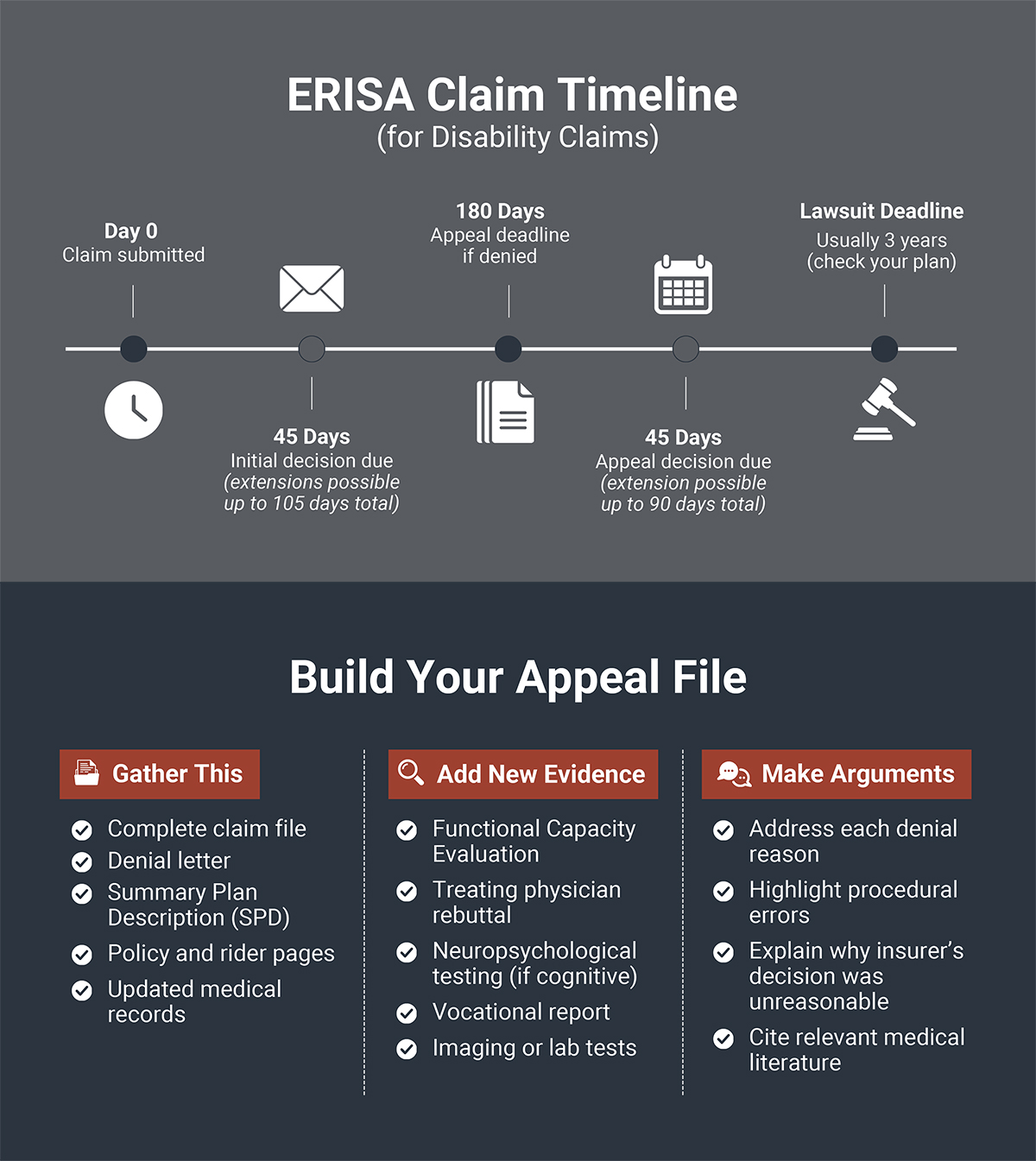
You have at least 180 days from the date of the denial to file your administrative appeal with the plan. The lawsuit deadline is set separately by your plan document, usually one to three years.
The full timeline:
- 180 days to file your claim appeal
- 45 days for the plan to decide your appeal
- Plus 45 days extension if the plan notifies you
- Plan-document deadline (typically 1 to 3 years from denial) to file suit in the Northern District of Illinois
Federal courts enforce the plan-document lawsuit deadline. Missing it can permanently bar your case.
The appeal deadline and the lawsuit deadline are two different deadlines. Both matter.
How much does a Chicago ERISA attorney charge to handle a denied benefits claim?
Chicago ERISA attorneys typically work under one of three fee arrangements: contingency (the firm collects a fee only if the claim succeeds), hourly, or fixed-fee. For ERISA group cases, federal law (29 U.S.C. 1132(g)) allows the court to require the insurer to pay attorney fees when the claimant prevails, and the 7th Circuit follows this standard. DeBofsky Law uses all three fee structures for Chicago ERISA cases and pursues fee shifting where the case warrants it.
Contingency: The firm collects a fee only when the claim succeeds. The percentage is calculated against benefits recovered when the case resolves.
ERISA fee shifting: Federal law permits the court, acting within its discretion, to require the insurer to pay your attorney fees when you prevail or achieve a meaningful result. The 7th Circuit follows this standard. The firm pursues fee shifting against the insurer where the case warrants it.
The fee structure is documented in writing before any representation begins.
What rights do I have if my Illinois individual disability insurance claim is denied?
Under Illinois insurance law, individual disability policyholders can sue without exhausting an internal administrative appeal, have a right to a jury trial, can pursue full discovery, and may recover attorney fees plus additional damages of up to $60,000 under 215 ILCS 5/155 when the insurer’s conduct is found to be vexatious and unreasonable. These remedies are unavailable to ERISA group claimants because federal law preempts state remedies for employer-sponsored plans.
Differences from ERISA group claims:
- No requirement to exhaust an internal administrative appeal before suing
- Right to a jury trial
- Right to full discovery
- Bad faith remedy under state statute (attorney fees, costs, and additional damages of up to $60,000 when the insurer’s conduct is found to be vexatious and unreasonable)
- Consequential damages possible under contract law
The lawsuit is filed in Illinois state court or, where the parties are diverse, federal court in the Northern District of Illinois. DeBofsky Law evaluates which framework applies during the intake call.

“Thank you. A thousand times, thank you.”
“Mark, I’m not very good at saying thank you. But I’m going to try. I don’t know what I’d do right now, or where my mind would go, if I didn’t have someone like you beside me, who knows the whole case… There are dark places I could go, and to which I’m not going, largely because your help and the resultant safety net that provides. Thank you. A thousand times, thank you.”
Todd B | Client
Learn More About ERISA to Protect Your Rights

The Appeal You File Now Is the Case You Get Later
The Wall Street Times recently profiled our founding partner, Mark DeBofsky, and his four decades representing people whose disability, life, and accidental death benefits were denied. You can read it here: How Mark DeBofsky Is Helping Policyholders Pursue the...
The ERISA “Administrative” Record: How to Build the File That Wins Your Disability Appeal
If your long-term disability benefit claim was just denied, your first instinct is probably to gather more records and send them to the insurance company with the expectation that a little more evidence will suffice. That instinct is the right one, but the stakes are...

How Can I Tell If My Benefit Plan Is Governed by ERISA?
ERISA is an acronym for the federal Employee Retirement Income Security Act of 1974. Most people have never heard of ERISA, but its comprehensiveness impacts the vast majority of American workers and their dependents. The original intent behind ERISA’s enactment was to remedy pension plan abuses; however, just prior to Congress’ passage of the ERISA law, the scope […]