
Losing the ability to work due to injury or illness is hard enough. You shouldn’t have to fight with an insurance company over the disability benefits you deserve.
At DeBofsky Law, our attorneys are skilled at recognizing the traps and pitfalls common to disability insurance claims. We have successfully handled thousands of pre-suit appeals on behalf of disability claimants in Illinois and throughout the country, and have obtained justice for hundreds of clients in court.
Whether you are just thinking about applying for disability, your initial claim has been denied, or your insurer has terminated benefits they previously approved, we can assist to ensure you receive the benefits you deserve.
Types of Disability Insurance
There are many types of disability insurance, each with its own considerations. An experienced benefits attorney can help you understand the different types of coverage for which you may be eligible and how they interact.
Short Term Disability Insurance:
Employers typically offer Short term disability insurance, or you may purchase it through an individual policy of disability insurance. These disability benefits typically last three to six months and are intended to provide income replacement during periods of temporary disability or while satisfying the elimination period for long term disability benefits.
Long Term Disability Insurance:
Employers also commonly offer Long term disability insurance (LTD). This coverage provides income replacement, usually between 50 and 70 percent of your pre-disability income. Benefits begin after an elimination period of three to six months. Once approved, you can receive payments until you reach retirement age. However, you must remain continuously disabled, and no policy exclusions or limitations can apply.
Individual Disability Insurance:
You may purchase individual disability insurance from an insurance broker. This coverage operates independently from any employer-sponsored benefits you may have. Similar to long term disability insurance, individual policies provide income replacement until you reach retirement age. The benefit amount is fixed at the time of purchase or during subsequent policy renewals. You must meet all other policy criteria to continue receiving payments.
Social Security Disability Insurance:
Social Security disability insurance (or SSDI) is a governmental disability benefit available to people who have paid sufficient premiums in the form of FICA taxes. The criteria for qualifying for Social Security disability insurance is usually more stringent than the other types of insurance discussed above. (DeBofsky Law does not handle Social Security disability claims.)
How Does the Disability Insurance Claim Process Work
The disability insurance claim process involves strict deadlines and complex requirements that vary between ERISA and individual policies. Here’s how the process typically unfolds:
Know Your Rights
You are potentially eligible for many different kinds of disability compensation, including:
- Retroactive (past-due) benefits
- Future benefits
- Interest paid on past-due benefits
- Attorney’s fees
Work with attorneys who know how to get you everything you deserve.
Does This Apply to You?
Contact DeBofsky Law for an attorney consultation. We will work with you to figure out your problem, and how we can help.
Why Choose DeBofsky Law
- 60+ years combined experience
- Thousands of successful appeals handled
- Nearly 100 published appellate decisions
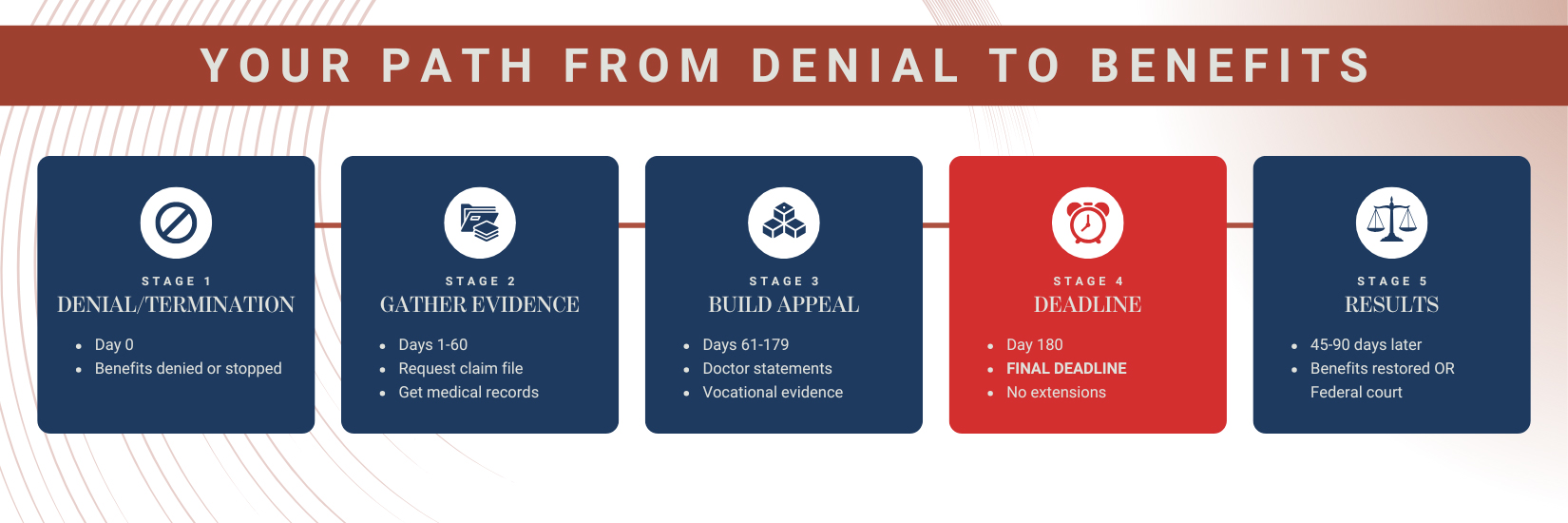
DeBofsky Law guides you through each stage, ensuring deadlines are met and evidence is compelling.
Common Reasons for Disability Insurance Claim Denials
Insurance companies use predictable tactics to deny legitimate disability claims. Understanding these tactics helps you prepare a stronger case:
- Occupational Misclassification: Insurers redefine your job as less demanding than it actually is. Learn more the important role of occupational assessment in our detailed guide
- Cherry-Picked Medical Records: Ignoring treating physician opinions and medical records while relying on their own paper reviewers
- Surveillance Misrepresentation: Using selective video clips out of context to claim you’re not disabled. Learn what to do if you are being surveyed
- The 24-Month Switch: Terminating benefits when the definition changes from “own occupation” to “any occupation”
- Pre-Existing Condition Exclusions: Broadly interpreting any prior medical treatment as pre-existing condition, excluding current disability
- Subjective Symptom Dismissal: Rejecting claims based on pain, fatigue, or cognitive issues they claim can’t be “objectively” proven
- Vocational Expert Manipulation: Using biased experts who find hypothetical jobs you supposedly can perform
DeBofsky Law knows these tactics and has successfully challenged them in hundreds of appeals and federal court cases.
Legal Rights When Your Disability Claim Is Denied
When your disability claim is denied, federal law provides specific protections:
- Access to Your Claim File: Insurers must provide all documents they relied on within 30 days of request
- Right to Full and Fair Review: Someone different from the initial decision-maker must review your appeal
- Abiliuty to Submit Evidence: You can provide new medical records, expert opinions, and arguments during your 180-day appeal window
- Explanation of Denial Reasons: Denial letters must cite specific policy provisions and explain what evidence would be needed to approve your claim

DeBofsky Law ensures insurers follow these requirements and holds them accountable when they violate your rights.
How to Prepare for Your Disability Insurance Claim Consultation
Preparing for your disability insurance consultation helps us evaluate your case immediately:

- Bring your denial or termination letter: This shows the insurer’s stated reasons
- Obtain a copy of your policy or policies: Your attorney will need to review your policy terms
- List your doctors and treatment dates: Include specialists, therapists, and hospitalizations
- Document your job duties: Not just your title, but what you actually did daily
- Note your policy source: Employer-provided or individual coverage affects your rights
- Timeline of symptoms: When limitations started versus when you stopped working
- Previous claims history: Any prior STD, LTD, workers’ comp, or SSDI applications
You don’t need everything perfect. We can help gather missing pieces. But this information lets us identify critical deadlines and strategies immediately.
When Should You Hire a Disability Insurance Attorney
It is never too soon in the process to engage the services of an experienced benefits attorney, whether you are just thinking of submitting a disability claim or if your benefits have been denied. Most group disability benefit plans fall under the ERISA statute, a federal law combining contract, trust, and administrative law. ERISA enforces some of the strictest deadlines in employment law. Missing these deadlines can permanently bar your lawsuit. Thus, as soon as you decide to submit a disability claim, or as soon as your claim is denied, it is prudent to contact an experienced disability benefits lawyer to discuss your claim and your options.
What Are the Benefits of Hiring a Disability Insurance Lawyer?
Understanding Your Benefits:
An experienced disability insurance lawyer can counsel you as to the benefits provided under your disability insurance plan or policy. Sometimes, just obtaining the plan document can be a challenge. And, once received, it can sometimes be hard to know whether the plan document (or documents) are complete, current, and not invalidated by state law. Moreover, all disability insurance policies contain exclusions or limitations.
An experienced disability insurance lawyer can help you to obtain the relevant policy or plan documents and counsel you as to the meaning of the plan terms to ensure your rights are protected.
Proving Your Claim:
An experienced benefits attorney can also help to ensure your disability claim has sufficient medical support. A diagnosis, alone, is usually not sufficient to establish disability. Rather, you must have the support of a treating doctor. Likewise, a statement from your doctor that you are “unable to work” is usually not sufficient to receive disability benefits. Instead, your doctor must identify restrictions and limitations that would preclude you from performing the material duties of your job (e.g., limited tolerance for sitting, standing, or walking; manipulative limitations; difficulty interacting with the public).
Those restrictions and limitations must be medically supported and consistent with the evidence as a whole. A disability insurance lawyer can help you identify what additional testing, if any, is needed to bolster your doctor’s opinion and substantiate your disability claim.
Identifying Vocational Arguments:
In addition to the medical evidence, vocational evidence is often critical to proving your disability claim. A favorite insurance company tactic is to misclassify or over-generalize occupations into a less physically or mentally demanding role. An experienced disability lawyer can prevent that from happening by documenting the material duties of your occupation as performed both by you and in the local and national economy. But proving you are unable to perform your former occupation is only half the battle.
Many group disability plans utilize a two-pronged definition of disability that provides two years of disability benefits if you are unable to perform the material duties of your “own” or “regular” occupation, followed by a more general “any occupation” standard of disability. An experienced disability lawyer can help you understand the difference between those two standards and devise a strategy so as to hopefully avoid an interruption of benefits at the two-year mark.
Transitioning From Work to Disability:
As you transition from work onto disability, you will likely have many questions. For instance, you may not be sure whether you should resign, retire, or simply remain silent about your intentions to return to work. Questions about impact on other benefits often arise, including your health insurance, life insurance, and pension benefits. Another common concern is if your employer can terminate you while you are on a disability leave.
Additionally, deciding whether you should accept a severance offer from your employer or apply for unemployment benefits requires careful consideration. An experienced disability lawyer can counsel you through these and other questions to ensure you maximize your benefits while avoiding later legal troubles.
How to Appeal After a Disability Insurance Denial?
If your disability claim is denied, you may be tempted to appeal as quickly as possible so as to minimize the interruption to your income, but that would be a mistake. Most disability insurers allow claimants up to six months to appeal a denial of benefits. While it may not be practical to use the entirety of that time, it is in your interest to take a few weeks or months to compile a compelling appeal submission. Better yet, it is prudent to hire an experienced disability lawyer to handle the appeal for you.
Most of the time, disability insurers are unlikely to overturn a denial of disability benefits absent new evidence or argument. Your first step in appealing a denial of disability benefits should be to request a copy of your claim file and disability plan or policy. The claim file will give you an idea as to the reasons for the denial and how to perfect your appeal. Common reasons for the denial of benefits include:
Incomplete Medical Records:
You may think the insurance company has your complete medical records, but oftentimes you would be wrong. Most insurance companies will only request records from the alleged date of disability onwards, except in the case of suspected pre-existing conditions. If you suffer from chronic health conditions, you may want to submit earlier medical records to show the progression of your impairment. Similarly, the insurer may have requested records from your doctor but not your hospital, or vice versa. Finally, if you previously received disability benefits, don’t assume that the records from that disability claim will be merged with the current claim without a written request by you.
Improper Vocational Analysis:
Just as the claim file may contain incomplete or adverse medical evidence, it can also contain adverse vocational evidence. Usually, this evidence takes the form of an “occupational analysis” or “transferable skills analysis” performed by a vocational expert for the insurance company. Often, those reports may be based on faulty assumptions, such as an inaccurate or incomplete job description, an incorrect understanding of your past work and transferable skills, or an improper residual functional capacity evaluation.
Whatever the issue, it is important to remember that in the case of disability, medical evidence is only half of the equation: the occupational or transferable skills analysis is equally important and requires your attention. Unfortunately, vocational analysis is a specialized undertaking that often requires consulting an expert. A disability insurance lawyer can advise you whether an expert report is necessary, or whether the submission of additional vocational evidence and argument will suffice to remedy the problem.
Adverse Opinion Evidence:
Very frequently, disability claims are denied based on the report of a non-examining, file-reviewing nurse or doctor employed by the insurance company. Those file reviews often ignore subjective complaints of pain and fatigue and the opinions of the treating physician. The claim file may also contain adverse opinion evidence from your own doctor. In either case, it is important to schedule a meeting with your doctor to discuss the report in question and, if your doctor is agreeable, ask him or her to write a letter of rebuttal or explanation. An experienced disability insurance lawyer can assist you in this process, or even talk to your doctor for you, to ensure the necessary points are addressed.
Other Pitfalls:
Besides the foregoing points, there are innumerable other kinds of errors and omissions a disability insurance company can commit in the course of deciding a disability claim, as well as additional types of evidence that may be of value. For instance, if you have been awarded Social Security disability benefits, you may want to obtain and submit a copy of your Social Security disability file, provided it supports disability due to a non-limited condition. Likewise, if your disability is primarily subjective in nature, you may want to keep a symptom diary to submit in support of your appeal.
A disability insurance lawyer can counsel you as to what additional evidence and argument is necessary to maximize your chances of success on appeal.
Contact a Disability Insurance Attorney in Chicago, IL
If you are thinking of applying for disability benefits, or if your claim has been denied and you wish to appeal or litigate, the experienced attorneys at DeBofsky Law can assist. With over sixty years of combined legal experience, and nearly 100 published appellate decisions to our name, we pride ourselves on taking cases to judgment and nudging the case law in favor of claimants whenever possible. As our founding partner, Mark DeBofsky, likes to say, “We don’t just follow the law. We make the law.” We encourage you to contact us today regarding your disability insurance claim.

Frequently Asked Questions About Disability Insurance
What is disability insurance?
Disability insurance replaces part of your income when an illness or injury prevents you from working. Most policies are offered through an employer under ERISA or can be purchased privately. These benefits are meant to provide financial security so you can focus on recovery instead of worrying about lost wages.
How do I file a disability claim?
What should I do if my disability claim is denied?
Can my insurer terminate benefits after approving them?
Can I claim disability insurance if I'm laid off?
How long does the disability appeal process take?
What is the difference between a group and individual disability insurance policy?
A group policy is purchased by your employer and is generally governed by ERISA. An individual policy is purchased directly by you and is governed by state law.
The difference controls three things:
- Appeal procedure. ERISA requires you to complete an administrative appeal with the plan before filing suit. Individual policies typically allow you to go directly to court.
- Available remedies. ERISA limits recovery to the benefits owed plus, when you prevail, attorney fees. Many state-law individual-policy claims allow consequential damages, bad faith damages, and in some states punitive damages.
- Venue. ERISA cases are heard in federal court with limited discovery and no jury. Many individual-policy cases can be heard in state court with full discovery and the availability of a jury trial.
Identifying which framework applies is one of the first analytical steps in evaluating your case.
Are disability benefits taxable?
Will other benefits reduce my disability payout?
What types of disabilities do you handle?
What do I need to do before applying for disability insurance benefits?
Can an insurance company delay or deny my legitimate disability claim?
My disability insurer keeps requesting more medical records and updated forms. Do I have to keep providing them?
Yes. Disability benefits run month to month, so technically, the insurance company can request updates each month. Requests are generally more frequent at the beginning of a claim or if material improvement is expected. Requests can also be more frequent if the claimant is continuing to work and benefits are subject to calculation each month. Refusing to respond can lead to a benefits termination for failure to cooperate.
What insurers typically request:
- Updated attending physician statements
- Recent medical records
- Claimant questionnaires
- Authorizations for additional records
- Updated earnings or monthly profit and loss statements
The risks:
- Refusing to respond can lead to a benefits termination for failure to cooperate
- Responding without sufficient care can hand the insurer evidence to argue improvement or inconsistency
Smart approach:
- Comply with reasonable requests
- Keep copies of every document you submit
- Consult an attorney before signing broad authorizations or completing forms with vague activity questions
For ERISA group plans, federal regulations limit the insurer to “reasonable” requests; what is reasonable is determined by the regulations and the plan terms. For individual policies (purchased on your own), the contract terms govern what the insurer can request and how often. In either case, escalating volume or specificity may signal an upcoming termination. Engage counsel.
Our Recent Victories
We know the tricks insurers and plan administrators use to deny claims. We’re here to fight on your behalf. See How We’ve Won Your Rights.
Disabilities Insurance | Covid Syndrome
Ward v. Reliance Standard Life Insurance Co.
DeBofsky Law achieved a favorable ruling where the court found that Reliance Standard Life Insurance Company abused its discretion in terminating long-term disability benefits for COVID syndrome. The court determined that the insurer failed to properly consider comprehensive medical evidence of cognitive impairments. Consequently, the case was remanded for further proceedings to ensure a thorough review of the disability claim.
Long Term Disability Insurance
Robinson v. Aetna Life Ins. Co.
DeBofsky Law won two cases for our client. In the first, the court denied Aetna’s motion to dismiss, noting the plan did not address retroactive SSDI awards. The judge found Robinson’s claim was not time-barred due to her voluntary appeals. In the second, the court ruled the denial of benefits arbitrary and capricious due to Robinson’s retroactive SSDI award and found Aetna’s refusal to toll its review problematic.
Disabilty Insurance & ERISA Ruling
Scanlon v. LINA
A system analyst with spinal pain and a sleep disorder won his appeal with the help of DeBofsky Law. The court ruled that the district court erred in its assessment, failing to properly consider the claimant’s functional capacity and inability to earn 80% of his income due to his condition. This decision underscores the importance of thorough evaluations in long-term disability cases, especially the impact on job performance.

“I could not have made it through without you.”
“Thank you so much for helping me. I apologize for being a complete, frantic, panicked client. I know my cognitive issues were not helpful in trying to work through this scary and often unfair process. And with no one around me understanding the process; that was no help either. I appreciate your compassion, understanding + help. I could not have made it through without you. I think I would have quit + given up many times.”
Jen H | Client
Learn More About Disability Law to Protect Your Rights

8th Circ. Ruling Raises Bar For Seeking Disability Benefits
The U.S. Court of Appeals for the Eighth Circuit recently underscored the difficulty of securing Social Security disability benefits. In Post v. Bisignano, the court affirmed the denial of benefits to a claimant whose hand, arm and shoulder impairments had required...

The ERISA “Administrative” Record: How to Build the File That Wins Your Disability Appeal
If your long-term disability benefit claim was just denied, your first instinct is probably to gather more records and send them to the insurance company with the expectation that a little more evidence will suffice. That instinct is the right one, but the stakes are...

When Your Disability Claim Is Denied Because the Insurer Says You Were Not Actively at Work
You filed a long-term disability claim. Your doctors support you. The medical evidence confirms you cannot work. Then the denial letter arrives, and it does not mention your medical condition at all. Instead, the insurer points to a clause in your plan called the...