

If you suffer from a medical condition that results in physical restrictions and limitations, a functional capacity evaluation (also known as an “FCE”) can measure your physical functional ability concerning your specific job duties and essential work functions. The evaluation should demonstrate the combined effect of all your symptoms. While functional capacity evaluations are not appropriate or necessary in every case, they can be beneficial in many instances, particularly when you are applying for disability benefits.
What Is the Purpose of a Functional Capacity Evaluation?
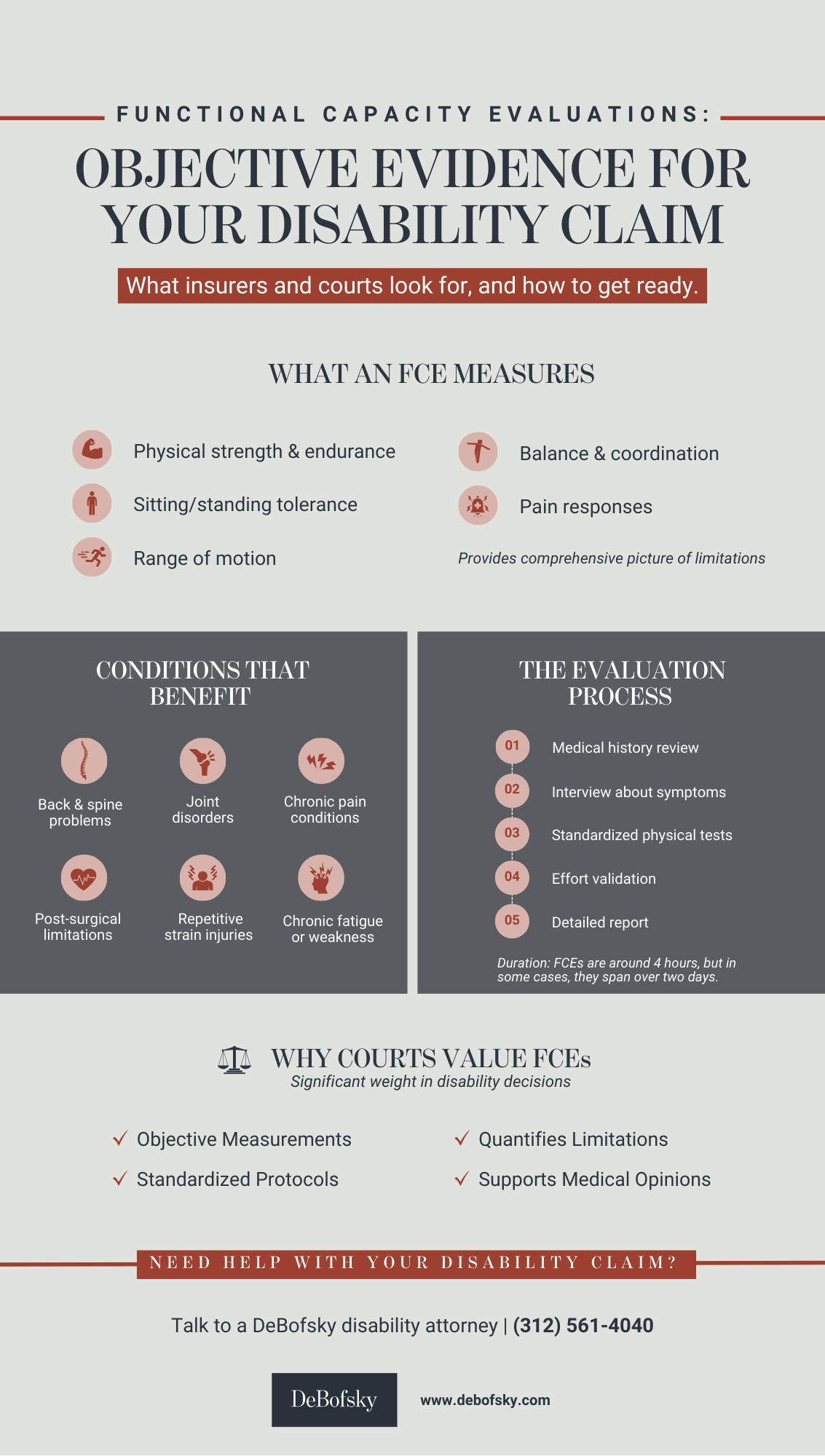
A functional capacity evaluation consists of a battery of standardized tests that objectively measure your physical functional abilities. A functional capacity evaluation may be specifically designed to measure certain medical conditions’ effects compared to specific physical, occupational demands to assess disability status. Functional capacity evaluation can be used for various other purposes as well, including developing a rehabilitation plan and increasing your ability to perform daily activities. Functional capacity evaluation can be beneficial when filing a claim for disability benefits because it can help quantify the extent of your limitations and restrictions compared to your specific job duties. In addition, because the functional capacity evaluation results are based on objective testing, they tend to be given significant weight by disability insurers and the courts.
Who Can Benefit From a Functional Capacity Evaluation?
While a functional capacity evaluation may not be helpful in every case, certain types of medical conditions are best suited for this type of evaluation. These include spinal and other orthopedic impairments; movement and balance disorders; and other physical conditions that involve pain, weakness, fatigue, numbness, and poor dexterity.
Even claimants whose jobs are sedentary, i.e., largely desk-based, can benefit from a functional capacity evaluation in certain instances. Tests such as sit-stand tolerance and hand-dexterity drills capture limitations that are less visible than lifting restrictions, but can be just as limiting.
Note: If your disability involves cognitive impairments, memory issues, or mental health conditions, a neuropsychological evaluation may be more appropriate.
Related Article: What Is a Neuropsychological Evaluation in a Disability Claim?
Who Performs a Functional Capacity Evaluation?
Qualified medical professionals should administer functional capacity evaluation. They are most often performed by occupational therapists or other physical medicine and rehabilitation specialists. Even if your doctor or physical therapist does not fulfill these types of evaluations, they can likely refer you to a therapist that does. If not, physical therapy companies and other vendors can arrange for a functional capacity evaluation designed to assess your specific medical condition and occupational demands.
When selecting an FCE provider, consider:
- Ask your treating physician for a referral to a qualified evaluator
- Confirm they use standardized testing protocols
Discuss any needed accommodations for your condition
What Will the Functional Capacity Evaluation Entail?
Before attending your functional capacity evaluation, the evaluator will likely review your pertinent medical records, occupational history, and current job demands. At the beginning of the assessment, the therapist or doctor will probably interview you to learn more about your medical history and current diagnoses, symptomatology, and treatment plan. After that, the evaluator will perform testing to measure your physical endurance, strength, range of motion, postural intolerances, balance, and ability to perform fine and gross manipulations. The evaluation will also measure and account for your pain and fatigue levels. Finally, the functional capacity evaluation will include symptom validity tests to ensure you are putting forth your total effort and confirm the results obtained.
Common Components of a Functional Capacity Evaluation Include:
- Lifting and Carrying: Tests maximum safe weightlifting and carrying capacities, and frequency.
- Positional Tolerance: Measures how long you can sit/stand, which can be critical for office jobs.
- Repetitive Hand Movements: Tests assembly-line type motions and handling/fingering-related duties.
- Ambulation: Measures walking distance and stair climbing.
- Cardiovascular Response: Monitors fatigue and heart rate to show whether you can sustain activity throughout a workday.
Important: Always report symptoms immediately during testing.
How Long Does It Take To Perform a Functional Capacity Evaluation?
The length of functional capacity evaluation varies. Some functional capacity evaluations last approximately half a day, while others may be a full day. Some functional capacity evaluations are even held over two full days. The length of the assessment depends on your medical condition and the extent and intensity of the testing involved. The value of a two-day review is that it can measure your sustained functionality over an extended period to show why you cannot meet a regular, full-time work schedule.
How Much Does a Functional Capacity Evaluation Cost?
The cost of a functional capacity evaluation can range based on a variety of factors. If you are referred for a functional capacity evaluation by your doctor, your insurance may cover it. If insurance coverage is not an option, you may need to pay out-of-pocket for the assessment. In that case, the cost will depend on the facility’s rates and the intensity, complexity, and duration of the evaluation.
If you have additional questions regarding functional capacity evaluation, whether undergoing a functional capacity evaluation would benefit your medical condition, or your insurance company is requesting that you undergo a functional capacity evaluation to support your disability benefits claim, but you are uncertain about it, the experienced benefits attorneys at DeBofsky Law are here to consult with you to provide further guidance. You must receive the disability benefits you are entitled to, and we are here to help.
What Happens if Your Insurance Company Requests a Functional Capacity Evaluation
Sometimes, your insurer may request that you undergo a functional capacity evaluation, which they will arrange. Most disability policies include provisions permitting the insurer to require that a medical expert of their choice evaluate you. If so, and you decline to attend the evaluation, the insurer may use that as a basis to terminate your benefits.
If your insurer schedules a functional capacity evaluation, you should review your policy language first or consult with an attorney regarding your contractual obligations. If you proceed with the evaluation, you should request a copy of the report afterwards. You should also document your symptoms before, during, and following the evaluation. If the results are unfavorable to you or inconsistent with your current condition, you can consider scheduling your own functional capacity evaluation for comparison.
Key Case Examples:
- Scanlon v. Life Ins. Co. of N. Am., 81 F.4th 912 (7th Cir. 2023) – The Seventh Circuit’s 2023 decision provides crucial guidance on how courts should evaluate FCE results. The court emphasized that FCEs must be considered alongside treating physician evidence, not in isolation, and that insurers cannot cherry-pick momentary abilities while ignoring sustainable function limitations.
- Holmstrom v. Metro. Life Ins. Co., 615 F.3d 758, 770 (7th Cir. 2010) – The Seventh Circuit found that the claimant’s FCE “provided exactly the kind of detailed and specific information” required to show “objective support showing functional limitations amounting to total disability”
Courts recognize that disability determinations involve more than just your physical functional capacity. While Functional Capacity Evaluations assess physical abilities, insurers must also consider whether you can actually perform your occupation or other available work given your education, skills, and experience. For a comprehensive understanding of how vocational factors impact your claim, see our guide on the vocational aspects of disability insurance benefits.
Preparing for a Functional Capacity Evaluation With Simple Practical Tips
Before any functional capacity evaluation:
- Time it right – schedule the evaluation at a time when your symptoms are active, but the evaluation will not cause further damage to your condition, such as right after surgery or during a bad flare.
- Make sure your medical records are accurate, current, and up to date, and include your doctors’ supported restrictions and limitations so that they can be shared with the evaluator.
- Track your symptoms – Keep notes on your daily pain, symptomology, and limitations leading up to the evaluation and afterwards.
- Identify the evaluation vendor in advance and review its testing protocol.
If you have additional questions regarding functional capacity evaluations, whether undergoing such an evaluation would benefit your claim based on your medical condition, or if your insurance company is requesting that you undergo such an evaluation to support your claim, the experienced benefits attorneys at DeBofsky Law are here to consult with you to provide further guidance. You should receive all the disability benefits to which you are entitled, and we are here to help.
Contact our attorneys if you need guidance before scheduling a Functional Capability Evaluation.
Frequently Asked Questions About Functional Capacity Evaluations
What is a Functional Capacity Evaluation (FCE)?
A functional capacity evaluation consists of a series of physical tests that measure your ability to perform specific work-related activities, such as lifting, sitting, walking, and fine motor skills like fingering/handling abilities. The length of the evaluation can vary depending on the complexity of your case. After the evaluation, a detailed report will be created documenting your physical limitations and capabilities. Insurance companies often use these evaluations to determine whether you can return to work.
What should I do if my insurance company requests a Functional Capacity Evaluation?
Your ability to refuse to attend an evaluation scheduled by your insurer depends on your specific policy language. Many disability policies do not explicitly require functional capacity evaluations, though. Before making any decision, review your policy carefully and consult with a disability attorney to understand your options and ensure you are fully informed.
How should I prepare for a Functional Capacity Evaluation (FCE)?
In addition to practical preparation, make sure the evaluation measures the right standard for your claim: your ability to perform work reliably and consistently over time, not what you can do briefly in a clinical setting. If your job has specific physical demands, bring (or be prepared to describe) the actual duties you perform so the results aren’t interpreted using a generic “sedentary” job description.
After the FCE, request the report promptly and review it for accuracy. If the report is incomplete or contains errors, correcting it quickly can be important—especially in ERISA claims where the insurer may rely heavily on the written record.
What happens if I cannot complete the Functional Capacity Evaluation tests?
You should never push beyond your safe limits during testing. If pain, fatigue, or other symptoms prevent you from completing a particular test, tell the examiner immediately and stop the activity. You should also make sure to document those symptoms after the evaluation.
What should I do if the Functional Capacity Evaluation report contains errors?
You should thoroughly review the report generated after the evaluation and document all inaccuracies immediately upon receiving it. Common errors include misstated symptoms, incorrect test results, or omitted limitations you demonstrated. Share the report with your attorney and treating physician right away, and prepare a written list of all errors to challenge the findings, if necessary.