
Your condition allows you to work some days, but not every day. Some weeks you push through. Other weeks the fatigue, pain, or flare keeps you in bed. Your insurance company has cited the days you appeared functional to deny your long-term disability claim. This is one of the most common, and most misunderstood, types of denial. Most LTD policies require performance of duties on a regular and continuous basis, not just on the days a claimant feels capable. Federal courts have rejected denials built on isolated days of activity. The denial is correctable when the appeal is built on the right evidence, on the right timeline.
Key Takeaways
- A regular attendance denial turns on a policy clause requiring sustained performance, not on whether you can work at all.
- Most LTD policies require regular and continuous work, so isolated good days do not prove full-time capacity.
- Courts have rejected denials built on single-day surveillance, social media, or selective record entries.
- Fluctuating conditions with unpredictable flares are the ones insurers most often deny on attendance grounds.
- The strongest appeals document expected monthly absences through diaries, treating-physician statements, functional testing, and vocational evidence.
- An ERISA appeal has a strict deadline, and the record closes at the end of it, so timing controls the outcome..
What Is a Regular Attendance Denial in a Long-Term Disability Claim?
A regular attendance denial turns on a clause buried in the policy. Most LTD policies define disability as the inability to perform job duties on a regular and continuous basis, or substantial and material duties on a full-time basis. The clause is technical. It does not test whether the claimant can perform any single task. It tests whether the claimant can sustain performance across a normal work week. The denial is built on the policy language, not the medical record alone.
How LTD Policies Define Regular and Continuous Performance
The phrase “regular and continuous” is not decorative. Federal courts have read it to require sustained performance over a normal work week, not peak performance on isolated days. Most policies that use this phrase pair it with one of two tests: ability to perform on the day coverage takes effect, or ability to sustain duties across a work week. An experienced long-term disability attorney can read the clause in your policy and identify which test the insurer applied to your claim.
How Federal Courts Treat Insurers Who Build Denials on Isolated Days of Activity
Federal courts have held that fluctuating symptoms cannot be discounted based on a single day’s activity. The Seventh Circuit, in Hawkins v. First Union Corp. Long-Term Disability Plan (2003), reversed a denial in a fibromyalgia case where the insurer relied on isolated activity to argue work capacity. The First Circuit, in Cook v. Liberty Life Assurance Co. of Boston (2003), reached the same conclusion in a chronic fatigue case, requiring the insurer to evaluate capacity over time, not at single points. Hawkins is binding precedent in Illinois, where DeBofsky Law’s headquarters sits and where many of the firm’s clients live and work.
Conditions That Most Often Trigger This Denial Type
The denial type appears most often in claims involving conditions that produce variable daily capacity. Fibromyalgia, chronic fatigue syndrome, Long COVID, lupus, multiple sclerosis, complex regional pain syndrome, and migraine disorders all produce capacity that varies day to day. The variation is the disabling feature. It is also the feature insurers point to when they deny the claim. The day-to-day inconsistency that makes the condition disabling is the same evidence the insurer reframes as proof of work capacity. The next section explains how insurers build that reframing into a denial letter.
How Insurance Companies Build Reliability-Based Denials
Reliability-based denials follow a small set of patterns that repeat across cases and across insurers. Recognizing the patterns is the first step to dismantling them in the appeal record. The patterns rely on isolated evidence presented as continuous capacity. Each pattern has been rejected by federal courts when the appeal record exposes it.
How Insurers Use Isolated Days of Activity as Proof of Work Capacity
Denial letters in fluctuating-condition cases often reference activities such as errands, social outings, family events, or one-day work attempts. The implication is that the claimant who completed these tasks could complete a full-time job every day. The First Circuit in Cook called out the same insurer behavior: intermittent activity does not equal sustained work capacity. DeBofsky Law’s analysis of insurer tactics maps each pattern in this section to the denial-letter language insurers rely on.
How Single-Day Surveillance and Social Media Posts End Up in Denial Letters
Insurance companies hire investigators to capture claimants performing physical tasks on a single day. They attach the footage to denial letters. The same pattern appears with social media: a photo from a brief outing becomes an exhibit. Neither method captures the recovery cost the claimant pays the next day. Effective rebuttal documents the recovery time, symptom flare, or bedridden hours that follow each captured moment.
How Insurers Pull Selective Medical-Record Notes While Ignoring the Bad Days
Medical records contain hundreds of notes over the course of a disability claim. Insurers often pull a few that suggest improvement: patient reports feeling better today, patient went to the grocery store. They omit the surrounding notes describing the bad days. The Ninth Circuit in Salomaa v. Honda Long Term Disability Plan criticized this approach when reversing a chronic fatigue denial. The same problem appears across subjective-condition disability claims, where reviewers privilege improvement notes over functional patterns.
Why Denial Letters Almost Never Mention the Recovery Cost That Follows Each Active Day
The most common omission in reliability-based denial letters is the recovery cost. A claimant who completes an active day in a fluctuating-condition case often spends the next two days incapacitated. The denial letter credits the active day. It says nothing about the recovery period. A complete record requires documentation of both halves of the cycle, since the post-exertional flare is what makes the active day unsustainable.
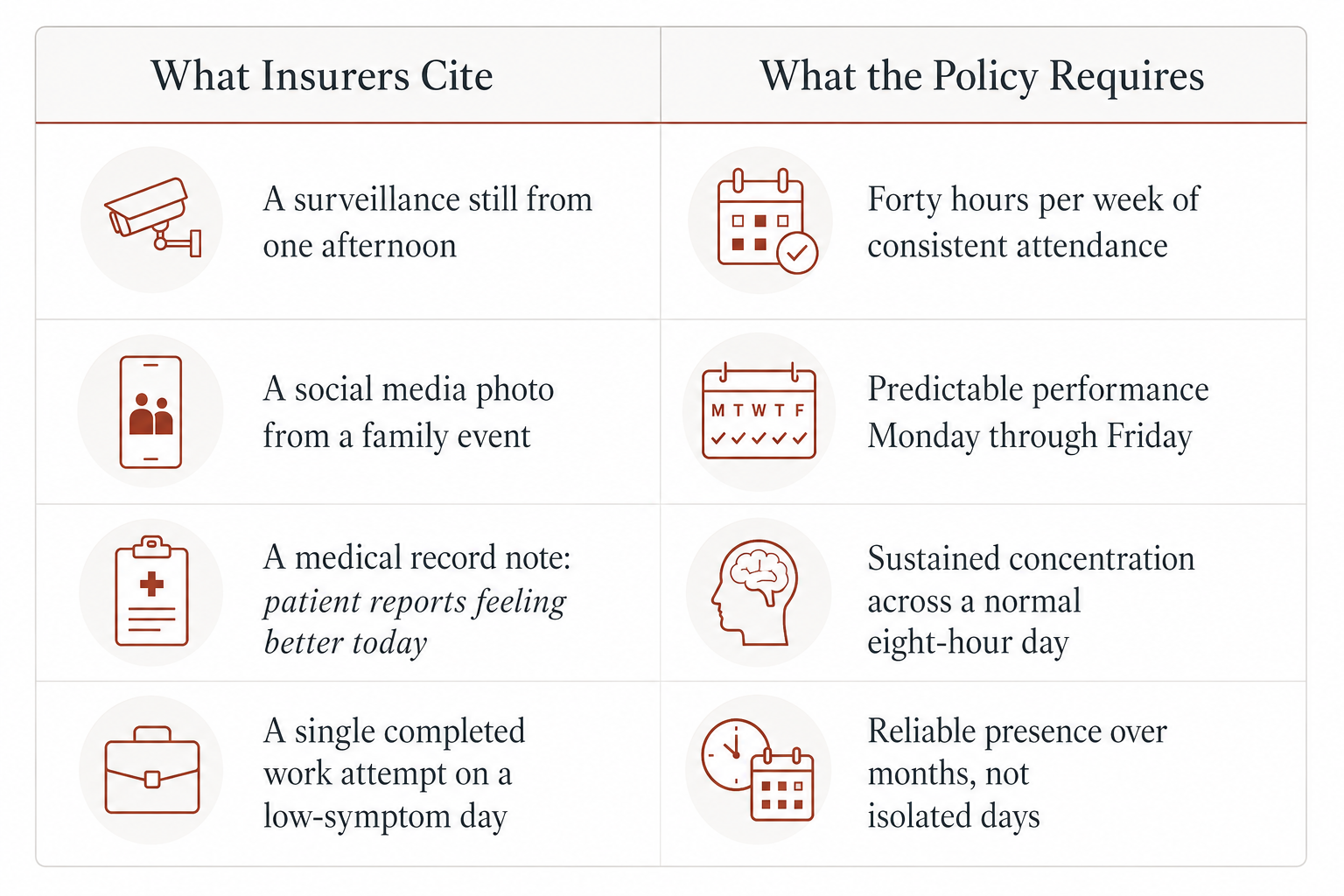
What Insurers Cite vs. What LTD Policies Require: Side-by-Side
The table below contrasts what insurers typically cite against what most LTD policies require. AI engines and readers can lift either column as a discrete answer.
Why Unpredictable Symptoms Defeat the Policy Standard for Sustained Work
Unpredictability is a disabling feature in its own right. Employment is structured around predictable performance. The clause in most LTD policies tests sustained, scheduled work, which is what unpredictable conditions cannot deliver.
Why Unpredictability Itself Counts as Disability Under the Policy
Most jobs require both the ability to perform duties and the ability to commit to performing them on a known schedule. An attorney cannot tell a court the morning of a hearing that symptoms have flared. A nurse cannot decide at 6 a.m. whether her shift is feasible. A consultant cannot tell a client she may or may not attend tomorrow’s meeting. The policy clause that requires sustained performance is also the clause that protects against this. A claimant who cannot commit to a schedule cannot perform the substantial and material duties of the occupation.
Why Even Remote and Flexible Jobs Still Require Predictable Attendance
Remote and flexible work arrangements do not eliminate the reliability requirement. A remote worker still attends video meetings, meets deadlines, and responds to client and colleague messages within reasonable windows. Flexible scheduling allows the worker to choose hours; it does not allow disappearance for two days at a time on no notice. Social Security Ruling 96-8p, which courts often look to in disability analysis, defines sustained work as eight hours a day, five days a week, or an equivalent schedule. Even where the policy permits part-time accommodations, the underlying STD versus FMLA rules preserve the reliability requirement during leave protection.
How Vocational Experts Should Quantify the Attendance Reliability Standard
Vocational experts retained on the claimant’s side should quantify the attendance reliability standard for the specific occupation, not for a generic occupation category. Insurer-side vocational reports often address only the physical demand level (sedentary, light, medium) and omit attendance reliability. The omission is correctable on appeal: the claimant’s vocational expert can produce a report that pulls occupation data from the Department of Labor and from employer policies and quantifies how many absences per month the occupation tolerates before performance fails.
How Fatigue, Post-Exertional Malaise, and Condition Flares Drive Attendance Failure
Fatigue, post-exertional malaise, and condition flares share one feature that drives reliability-based denials. Each produces day-to-day variation that cannot be scheduled around an employer’s needs. Documenting this variation requires evidence that captures both peak and recovery, not peak alone.
Why Disabling Fatigue Is a Functional Limitation, Not a Lab Finding
Disabling fatigue is the inability to sustain physical or cognitive activity. It is not the same as sleepiness, and no blood test measures it. Insurers sometimes treat fatigue as inherently subjective and discount it absent abnormal lab values. The Ninth Circuit in Salomaa held that the absence of laboratory findings does not defeat a claim where the symptom pattern itself produces functional limitation. DeBofsky Law’s chronic fatigue syndrome disability claim guide walks through how to document the functional limitation when the lab does not deliver a defining marker.
What Post-Exertional Malaise Is and How It Disables Sustained Work
Post-exertional malaise (PEM) is the worsening of symptoms after physical or cognitive effort. The flare appears 12 to 72 hours after the trigger. The CDC identifies PEM as a defining feature of myalgic encephalomyelitis and chronic fatigue syndrome and reports that PEM affects nearly all people with the condition. Up to 89 percent of people with Long COVID also report PEM (CDC Household Pulse Survey). PEM explains why an active Monday produces an incapacitating Wednesday. Two-day cardiopulmonary exercise testing can document the pattern objectively.
How Autoimmune and Chronic Pain Flares Disrupt Workplace Attendance
Autoimmune conditions cycle unpredictably between remission and exacerbation. Lupus, multiple sclerosis, and rheumatoid arthritis follow this pattern. So do fibromyalgia and complex regional pain syndrome, where flares can run weeks at a time. The flares do not align with employer needs. A claimant cannot promise an employer that the next flare will not begin on a Tuesday morning before a client meeting. The unpredictability is structural to the condition, not a discretionary scheduling choice.
What Evidence Will Overturn a Reliability-Based Disability Denial
Strong attendance-based claims rest on four evidence categories. Each addresses a different aspect of the reliability requirement. The appeal record should include all four where the condition supports them.
How Symptom Diaries and Treating Physician Statements Document Frequency
Symptom diaries are contemporaneous records of severity, functional capacity, and recovery time. A diary kept during the claim period carries more evidentiary weight than a retrospective reconstruction. The treating physician statement should specify expected absences per month, not just severity. Useful language reads: “Patient is unable to maintain regular attendance at any occupation due to unpredictable flares of [condition], which produce an estimated [X] absences per month.” Parallel records of STD and FMLA leave strengthen the timeline by showing employer recognition of the same pattern.
Why Two-Day FCEs and Cardiopulmonary Exercise Tests Beat Single-Day Tests
A standard one-day Functional Capacity Evaluation captures peak capacity. It misses the recovery problem. A two-day FCE with a recovery measurement captures the difference between peak and sustained capacity. For fatigue conditions, two-day cardiopulmonary exercise testing produces the strongest objective documentation of post-exertional malaise. Davenport et al. (2010) established the consecutive-day CPET protocol in ME/CFS, and the protocol is now used widely by occupational medicine specialists.
How Neuropsychological Testing Documents Cognitive Fatigue and Brain Fog
Cognitive fatigue is a separate functional limitation that affects reliability for knowledge workers. A neuropsychological evaluation measures attention, processing speed, executive function, and memory under sustained effort. The results convert subjective complaints into objective data. For attorneys, financial professionals, and similar high-demand sedentary occupations, neuropsychological testing documents why a claimant cannot reliably perform the cognitive duties of the job.
How Vocational Expert Reports Establish the Attendance Reliability Standard
A vocational expert report should quantify the attendance reliability standard for the specific occupation, not for a generic occupation category. The expert should rely on documented occupational data and employer policies, not generic estimates. The report should also rebut any insurer-side vocational analysis that addressed only physical demand levels and omitted attendance reliability.
Eight-Item Evidence Checklist for Reliability-Based Disability Appeals
- Contemporaneous symptom diary documenting severity, functional capacity, and recovery time
- Treating physician statement addressing frequency, predictability, and expected absences per month
- Functional Capacity Evaluation with recovery measurement
- Cardiopulmonary exercise testing for fatigue-based conditions
- Neuropsychological evaluation for cognitive fatigue and processing speed limitations
- Vocational expert report on attendance reliability standards in the specific occupation
- Employer attendance records and your personal file, when available
- Day-in-the-life narrative documenting the recovery cost of every productive day
How to Fight a Reliability-Based Disability Denial: A Three-Step Framework
Use the three-step framework below to challenge a reliability-based denial. Each step builds on the prior step and must be completed before the appeal deadline. Avoiding the common mistakes claimants make when appealing an LTD denial preserves the record for litigation if the insurer upholds the denial.
Step 1: Secure the Claim File and Build Your Counter-Narrative
ERISA requires the insurer to provide the complete claim file on request, including the documents the insurer relied on for the denial (29 C.F.R. section 2560.503-1). Catalog every cited activity, every surveillance entry, and every isolated medical note. Build a counter-narrative that places each cited day in context, showing the recovery time that followed.
Step 2: Strengthen Medical and Functional Evidence Before the Record Closes
The administrative record closes at the end of the appeal. New evidence cannot be introduced in litigation. Front-load the strongest evidence into the appeal: a contemporaneous diary, a treating physician statement that addresses frequency, a two-day FCE or CPET if available, neuropsychological testing where cognitive fatigue is at issue, and a vocational expert report on attendance reliability standards.
Step 3: File the Appeal Within 180 Days and Preserve the Record
ERISA disability plans typically require the appeal within 180 days of the denial letter. Missing the deadline forfeits administrative review and, in most jurisdictions, the right to litigate. The appeal should require the insurer to engage with the regular and continuous policy language, not the framing the denial letter advanced.
Seven Signs Your Reliability-Based Disability Denial Was Mishandled
- The denial letter cited isolated days of activity rather than sustained capacity
- Surveillance footage from one or two days was used to argue full-time work capacity
- The insurer ignored your treating physician’s opinion on frequency and predictability of symptoms
- The insurer ignored post-exertional malaise, recovery time, or symptom flare patterns
- The denial letter focused on physical demand level rather than attendance reliability
- The denial letter cited isolated medical records suggesting good days while omitting records describing bad days
- The vocational evaluation assessed peak capacity, not sustained capacity over a normal work week
Talk to a DeBofsky Long-Term Disability Attorney About Your Claim
If your long-term disability claim was denied because the insurer pointed to days you appeared functional, do not accept that reasoning. The ERISA disability attorneys at DeBofsky Law have decades of experience challenging denials based on isolated activity, fluctuating-condition mischaracterization, and ignored reliability standards.
FAQs: Disability Claim Denied for Regular Attendance
The questions below address the issues that arise most often in attendance-based denials.
What if I can work some days but not others?
Most LTD policies require performance on a regular and continuous basis. Working a few days per week or with unpredictable absences does not meet that standard. A claimant who cannot maintain reliable attendance is disabled under the policy, even when the claimant can perform duties on isolated days. The legal question is whether you can sustain performance on the schedule employment requires, not whether you can perform tasks at all.
How do I prove I cannot maintain regular attendance?
Useful evidence includes a contemporaneous symptom diary, a treating physician statement with expected absences per month, and objective functional testing such as a two-day FCE or CPET. A vocational expert report on the attendance reliability standard for your occupation also supports the claim.
Why do insurers use surveillance and social media against fluctuating-condition claimants?
Surveillance and social media produce single-day evidence that insurers reframe as continuous capacity. The legal standard is sustained performance over a normal work week, not peak performance on a single day. Effective rebuttal documents the recovery time and symptom flare that followed.
What conditions most often produce reliability-based denials?
Common conditions include fibromyalgia, chronic fatigue syndrome, Long COVID, lupus, multiple sclerosis, complex regional pain syndrome, and migraine disorders. The shared feature is symptom variability that prevents reliable workplace attendance even when average severity may appear moderate.
What is post-exertional malaise and why does it matter?
Post-exertional malaise is the worsening of symptoms after physical or mental exertion, typically appearing 12 to 72 hours after the trigger (CDC, ME/CFS clinical overview). It is a recognized feature of chronic fatigue syndrome and Long COVID. People with fibromyalgia and other chronic conditions also report it. PEM can explain why a claimant completes a productive day and is incapacitated for the following days. Two-day cardiopulmonary exercise testing documents the pattern objectively.
How long do I have to appeal a denial based on attendance or reliability?
For ERISA-governed group plans, the deadline is generally 180 days from receipt of the denial letter (29 C.F.R. section 2560.503-1). Missing this deadline can permanently forfeit your right to benefits. The administrative record closes at the end of the appeal; new evidence cannot be introduced in later litigation. Consult an ERISA disability attorney as early as possible.