
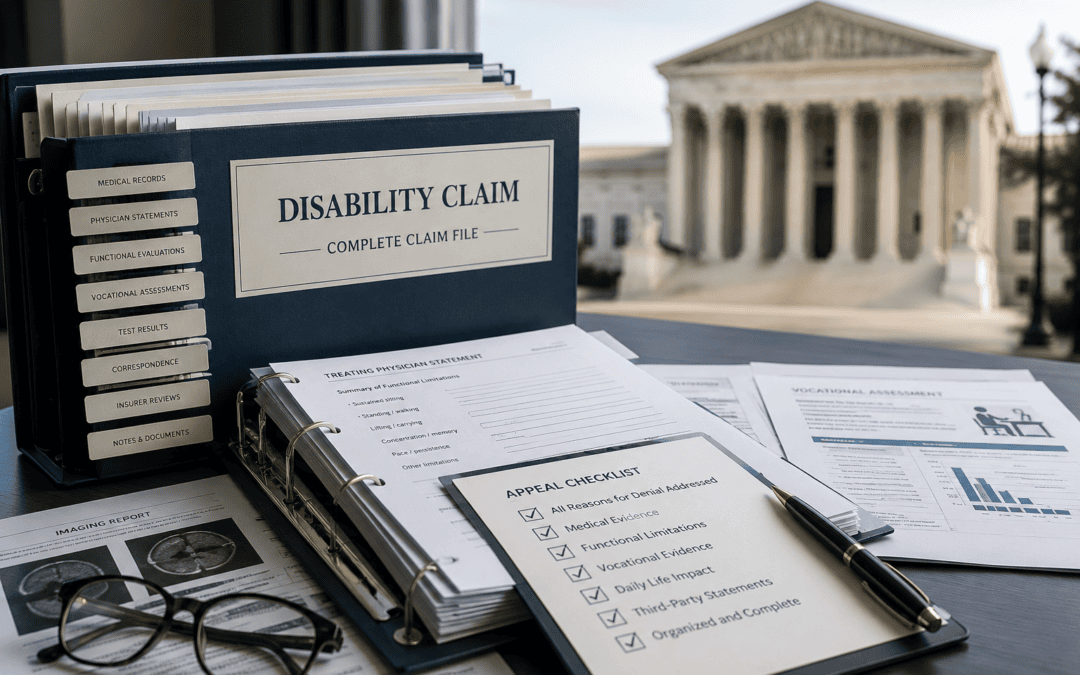
If your long-term disability benefit claim was just denied, your first instinct is probably to gather more records and send them to the insurance company with the expectation that a little more evidence will suffice. That instinct is the right one, but the stakes are higher than most people expect. In most ERISA disability cases, if the dispute later reaches federal court, a judge will generally review only the claim file compiled by the insurer during the claim and appeal, and will refuse to consider anything added afterward. Understanding this now is what gets your appeal to count. If you have not yet read our overview of why disability claims get denied, that is a useful starting point.
Key Takeaways
- The appeal is where you will likely have a final chance to submit evidence. A court generally reviews only the claim file created during the claim and appeal.
- Evidence that may be available but which is not submitted to the insurer prior to the close of the claim appeal usually cannot be added later in court.
- You have the right to receive your complete claim file at no cost, generally within 30 days.
- The deadline to appeal is usually 180 days from receipt of the denial letter, and missing it can end the case.
What Is the ERISA “Administrative” Record?
In everyday terms, what is misnamed as the “administrative record” is the complete claim file the insurance company used to decide your disability claim. It includes your medical records, the reports of any doctors the insurer hired to review your file, vocational or work-capacity assessments, surveillance if any was conducted, social media posts, the letters exchanged between you and the insurer, and the insurer’s internal notes. What surprises most readers is that this claim file, not anything said later in a courtroom, is generally what a judge will weigh.
The reason the term “administrative record” is a misnomer is because insurance companies, unlike the Social Security Administration, are not administrative agencies, and the claim process is not the same as procedures in administrative agency claims. The most critical difference is that Social Security claims are decided by independent administrative law judges following receipt of in-court testimony, while ERISA claims are decided by insurance claim adjusters.
Why a Court Usually Reviews Only the Administrative Record
An ERISA disability case in court does not work like an ordinary trial. There are no juries, in most instances, no live testimony, no opportunity to cross-examine the insurance company’s doctors and claim adjusters, and generally no opportunity to introduce new evidence. This surprises many claimants familiar with Social Security disability claims, where a claimant is entitled to a hearing before a neutral judge and gets to tell their story in person. An ERISA appeal works differently. It is decided on paper, by the insurer first, and a court later reviews that same file, often with a thumb on the scale in favor of the insurance company. The consequence: the appeal, not the lawsuit, is usually the critical stage, because by the time a dispute reaches court, the record is generally closed and the claimant faces an uphill battle.
Can the Insurance Company Control What Goes Into Your Claim File?
You have the right to request that the disability insurer provide you with its complete claim file at no cost, which is typically sent within 30 days of a written request. It must contain every document collected by the insurer relevant to the claim, not only the parts that support denial, including reviewer reports, internal notes, social media posts, and any surveillance video. Reading it early lets you see exactly why the claim was denied, so you can identify what is missing or one-sided before the appeal deadline arrives. In our ERISA litigation experience, a one-sided record is difficult to fix once frozen.
What Evidence Belongs in Your ERISA Disability Appeal
A strong appeal answers every reason the insurer gave for denying the claim, as though a court will eventually read it, because it may. Consider including:
- Treating physician statements that explain what you can and cannot do, not just your diagnosis, and not just the doctor’s opinion that you cannot work, since function rather than label decides a disability claim.
- Functional capacity evidence, such as a functional capacity evaluation, a neuropsychological evaluation, or other evidence providing proof of restrictions.
- Vocational evidence tying your limitations to the duties of your own occupation or any occupation, often where a claim is won or lost.
- Objective testing, where it exists, along with an explanation for conditions that do not produce classic objective findings, as covered in our article on objective medical evidence.
- Your own account of how the condition limits daily function, stated specifically and credibly.
- Third-party and witness statements from family, colleagues, or caregivers that corroborate the limitations.
Our pieces on avoiding common mistakes when appealing an LTD denial and responding to an insufficient-evidence denial go deeper into building this part of the record.
Your Right to See and Respond to the Insurer’s New Evidence
While your appeal is open, if the insurer obtains new evidence, federal rules require it to share that evidence and give you a fair chance to respond before deciding. Most claimants never realize they have this right. It means you can answer the insurer’s evidence while the record is still open, rather than learning about it in a courtroom. See what happens when an insurer fails to share adverse evidence.
How Insurers Argue Against Your Disability Claim, and How to Respond
- Paper-only file reviews, where a doctor who never examines you reads your file and opines that you can work. Counter with detailed treating-physician documentation and functional evidence.
- Independent medical exams, conducted by a physician the insurer chooses. These carry real weight, so know your rights and prepare accordingly.
- Surveillance and social media monitoring, used to argue you are more capable than you claim, where a single image can be misread.
- Selective reading of records or a disregarded Social Security approval, so make sure the full context reaches the record.
See all the ways a disability claim appeal can go wrong for more.
How Long the Insurer Has to Decide Your ERISA Disability Appeal
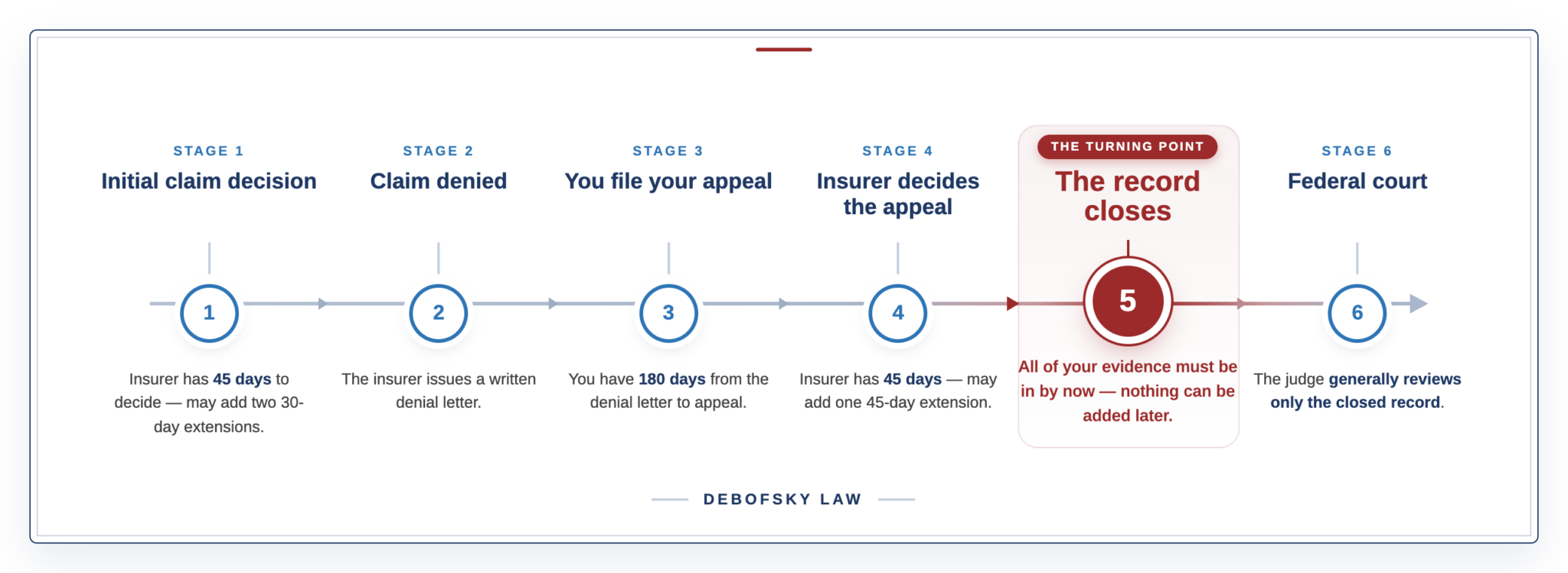
After you submit your appeal, the insurer generally has 45 days to decide, with one possible 45-day extension for special circumstances. If it asks for additional documents, the clock can pause until you respond. Track these dates and treat silence past the deadline as a reason to seek advice.
What Happens If the Record Is Already Closed
Once the record closes, your options narrow sharply, and a court will generally work only with what is already in the file. Narrow exceptions exist for misleading insurer conduct or a documented emergency, but these are rare and should not be counted on. A thin, closed record gives a court little to act on.
When to Get Help With Your ERISA Disability Appeal
Because the appeal is the stage where your evidence has to be complete, getting help before the record closes matters far more than getting help after. An experienced attorney can identify what your file may be missing and make sure every reason for the denial is answered on the record. If your benefits have been denied or terminated, the attorneys at DeBofsky Law can help you build your record while there is still time. Contact us to discuss your claim. For cases that proceed to litigation, judicial standards of review can also affect what a court considers.
ERISA Administrative Record: Common Questions
How do I get my claim file from the insurance company?
Request it in writing immediately after receiving a denial. The insurer must provide it at no cost, generally within 30 days. Ask for everything: medical records, reviewing doctors’ reports, vocational assessments, surveillance materials, internal notes, and all correspondence. Requesting the file is your right under federal law, and the insurer must respond at no charge. Ask as well for the summary plan description and any internal guidelines the insurer used, since those show the rules your claim was measured against.
How long do I have to file an ERISA disability appeal?
Generally 180 days from the date of your denial letter. This deadline is strict, and missing it can end your right to sue in federal court. Treat it as firm, and begin gathering evidence early. If you miss the deadline, the insurer is usually not required to accept the appeal, and you can lose the right to sue at all, because you must complete the appeal before going to court. Courts extend this deadline only in rare cases, such as misleading conduct by the insurer or a documented emergency.
Can I add new evidence after my ERISA appeal is denied?
In most cases, no. Once the insurer issues its final decision, the record generally closes, and a federal court usually considers only what is already in it. Everything supporting your claim belongs in the appeal, not saved for court. Narrow exceptions exist. Some courts allow limited new evidence when review is de novo rather than deferential, or when the insurer committed a procedural violation, but these are uncertain and should not be relied on.